

EAGLE-1: Advancing Europe's Leadership in Quantum Communications
- Date
- Categories
- Connectivity

Overview
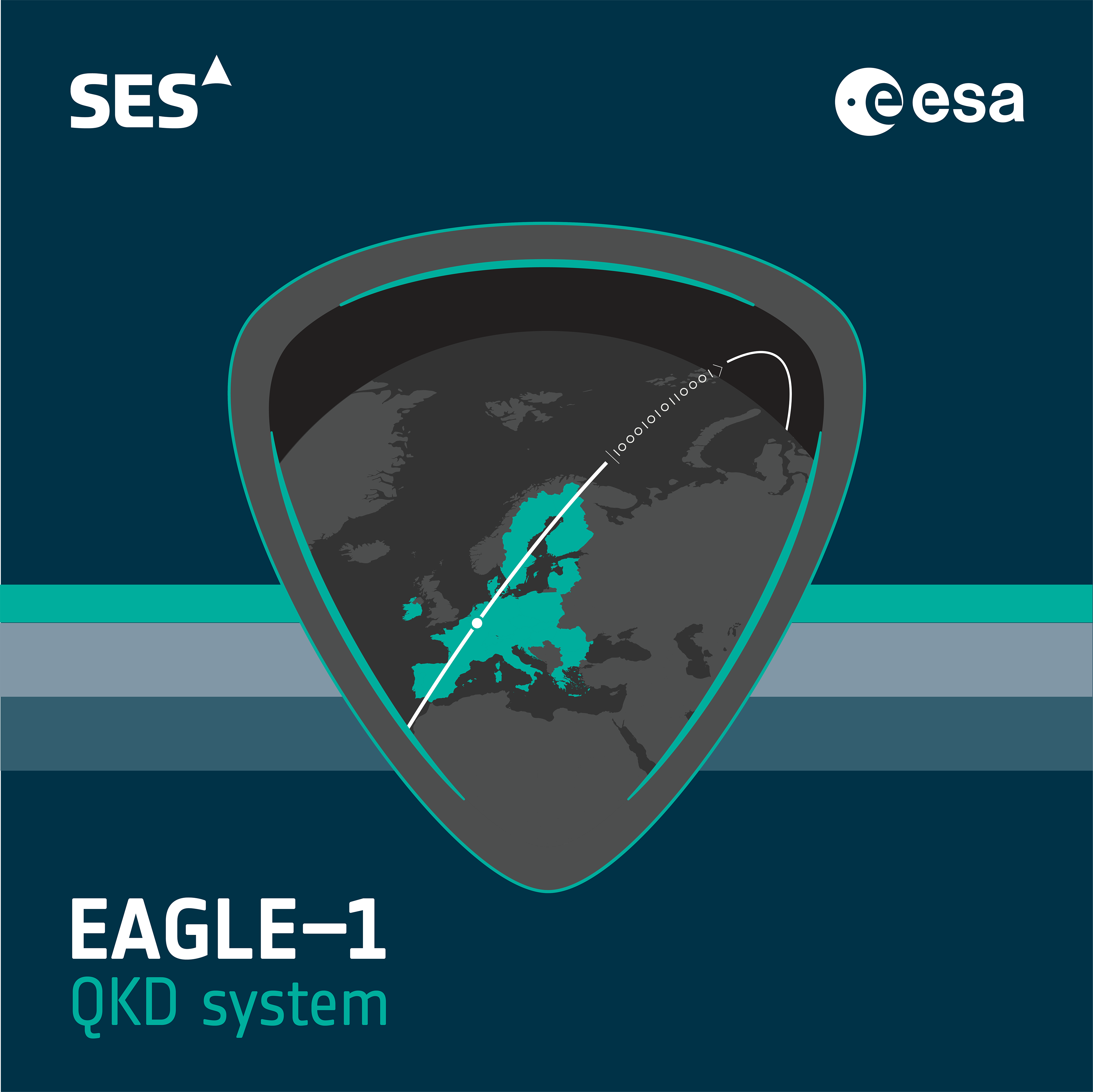
The EAGLE-1 system is a major technology breakthrough that paves the way for secure communications in the EU. Comprising a low-earth-orbit satellite and an extensive ground network, the space-based Quantum Key Distribution (QKD) system will jointly provide valuable mission data for a sovereign European end-to-end solution for secure QKD services.
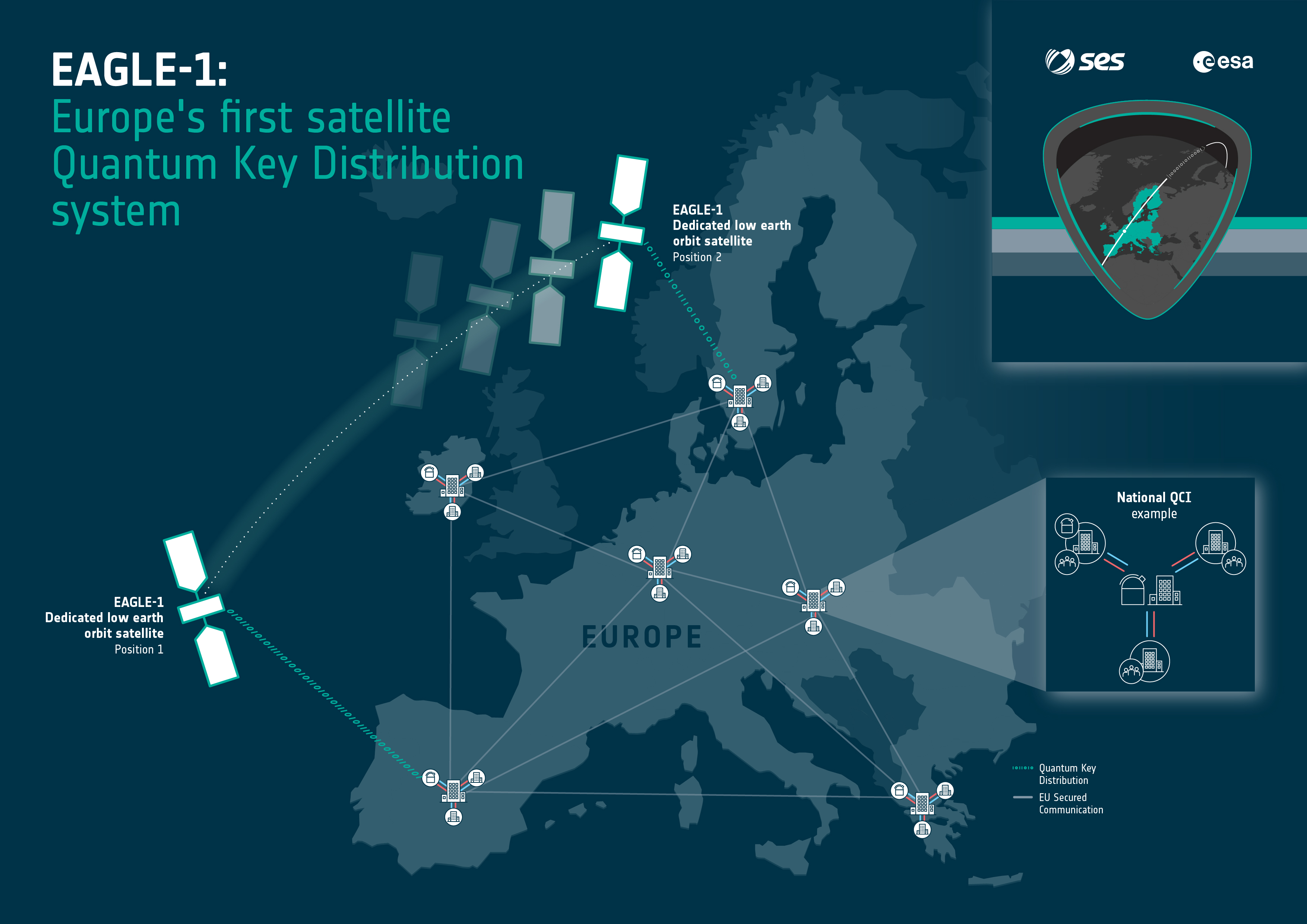
Under the EAGLE-1 project, the dedicated consortium of 20 European partners led by SES will develop and implement long-distance QKD. EAGLE-1 allows the validation of the key quantum secure communications systems and will also benefit the national Quantum Communications Infrastructures (QCIs) within the EuroQCI initiative.
The EAGLE-1 project is co-funded by ESA, the European Union (EU), the space agencies of Germany, Luxembourg, Austria, Italy, the Netherlands, Switzerland, Belgium and the Czech Republic, as well as the industry.
The EAGLE-1 satellite will be launched by Arianespace on the Vega C rocket from Europe’s Spaceport from French Guiana. The sovereign end-to-end space-based solution will complete three years of in-orbit mission supported by the European Commission, and it will provide the European Union governments, institutions and critical business sectors early access to long-distance QKD, pathing the way towards ultra-secure data transmissions across the EU.
The project onboarded TNO and Airbus to deliver the ground station for QKD. SES also joined efforts with TESAT to develop the EAGLE-1 payload. The satellite platform for the Quantum Cryptography System will be delivered by the Italian aerospace company SITAEL.
Learn more about the quantum technology fundamentals
The Eagle-1 QKD Protocol - From Science to Application
Dear EAGLE-1 stakeholder,
We are pleased to introduce you to the workshop entitled 'The Eagle-1 QKD Protocol - From Science to Application'. This workshop provides all the protocol knowledge necessary for anyone with sufficient experience to build their own EAGLE-1 compliant QKD receiver.
Session #1 on 13th November, 09:00 - 12:00
- Introduction by SES
- Presentation #1 - The Eagle-1 QKD protocol: Phase encoded BB84 decoy in a practical satellite QKD application (Kevin Guenthner, Friedrich-Alexander-Universität)
- Presentation #2 - The Eagle-1 time synchronization scheme (Conrad Roessler, Friedrich-Alexander-Universität)
- Q&A
- Wrap-up
Watch a replay of Session #1
Or download the recording of Session #1
Session #2 on 27th November, 10:00 - 11:30
- Dedicated Q&A session
Watch a replay of Session #2
In this document, you will find answers to questions raised during the QKD Protocol workshop, as well as other questions received in the meantime. The document may be updated if more questions are received.
Presentation abstracts
The Eagle-1 QKD protocol: Phase encoded BB84 decoy in a practical satellite QKD application
Kevin Günthner1,2, Conrad Rößler1,2, Bastian Hacker1,2, Ivan Derkach3, Vladyslav Usenko3, and Christoph Marquardt1,2
1 Friedrich-Alexander-Universität Erlangen-Nürnberg
2 Max Planck Institute for the Science of Light, Erlangen, Germany
3 Palacky University, Olomouc, Czech Republic
Eagle-1 is the first European satellite Quantum Key Distribution (QKD) mission with in-orbit demonstration. In this talk we report on the employed QKD protocol based on the BB84 decoy-state protocol using relative phase encoding, designed and optimized for operational satellite QKD. The QKD signal train does not only contain the quantum state exchange for key creation, but two additional time multiplexed parts, the dark and bright reference signals used for various purposes detailed in the presentation. The security proof is based on the rigorous finite-size techniques extended by several security aspects of the practical implementation. The talk gives all the information required to understand the protocol in the system context and to decode the signal on ground with a quantum receiver.
Download the corresponding slides to this talk
The Eagle-1 time synchronization scheme
Conrad Rößler1,2, Bastian Hacker1,2, Kevin Günthner1,2, and Christoph Marquardt1,2
1 Friedrich-Alexander-Universität Erlangen-Nürnberg
2 Max Planck Institute for the Science of Light, Erlangen, Germany
This talk describes the time synchronization concept of the Eagle-1 QKD protocol. The high loss experienced in satellite QKD is particularly disruptive for the weak and fragile QKD signals. Even for very fast modulated signals as in Eagle-1 only a few of the signals will arrive at the receiver. For successful key exchange, one must map each of the received states correctly onto the corresponding sent state, which is especially challenging for high rates and the resulting short time frames that need to be handled. In this talk we present our fast clock recovery algorithm, based on single photon clicks received from the bright reference signals time multiplexed with the quantum states. With this technique, we can cope with the Doppler effect experienced in satellite missions and achieve below nanosecond accuracy within less than a second.
EAGLE-neXt
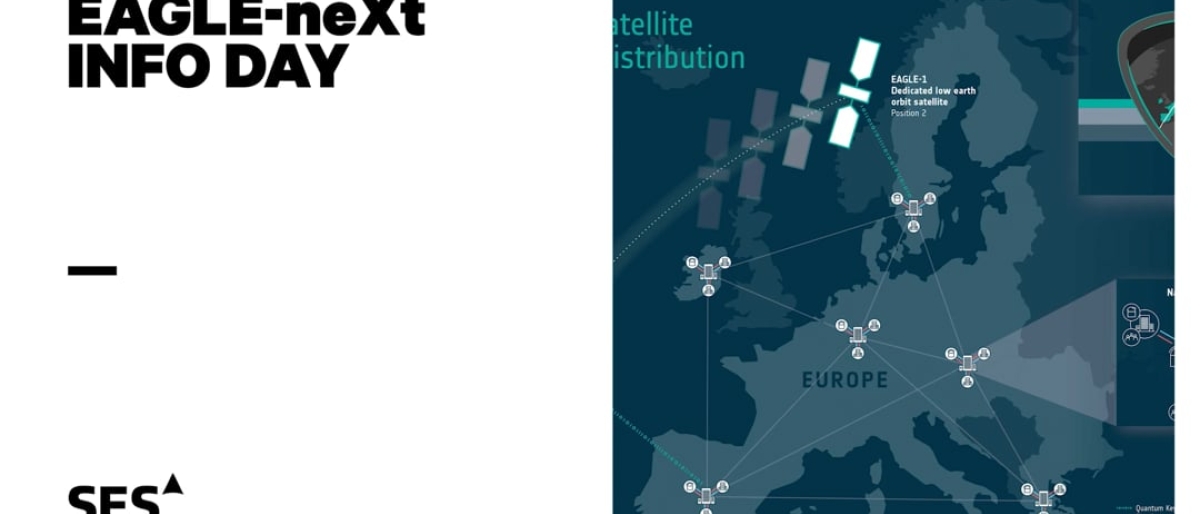
The EAGLE-neXt Info Day recording is now available and will allow you to learn about SES's initiative, which represents an important step towards the world's first satellite-based quantum-safe commercial service.
We invite European industry experts, technology providers and businesses to innovate together in advancing secure communications and building cutting-edge quantum technologies.